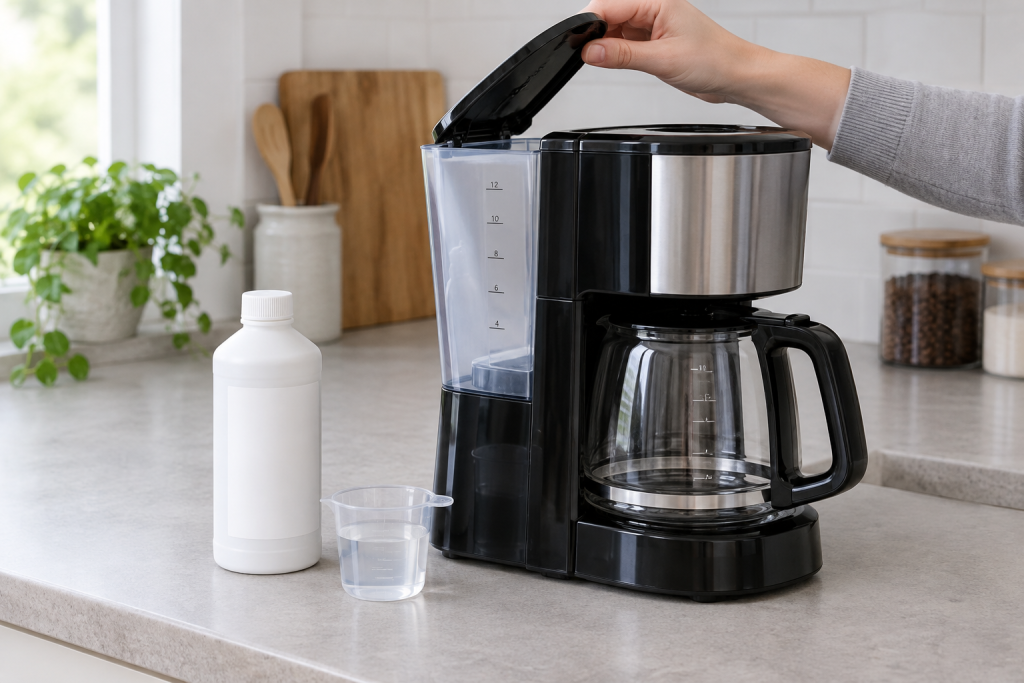
Pick the cleaner your brand allows
The same white vinegar that one manufacturer allows is ruled out by another, so settle the cleaner before anything else. Cuisinart allows a vinegar-and-water cycle on some of its drip models, and Mr. Coffee also endorses vinegar for its drip makers. A powdered descaler diluted to the label works on those machines too.
I'd skip vinegar on a Nespresso or a Breville. Both brands tell owners not to use it, and Nespresso wants the descaling solution it specifies. Keurig publishes its own instructions, so follow those instead of a general recipe. Then find your exact model's manual or support page, because amounts, pauses and rinse counts differ from model to model.
A Breville espresso machine that has never been descaled deserves extra care. Some owners say little or no water came out of the group head, or pressure dropped, once they started descaling after a long gap. If that describes your machine, stick to Breville's instructions and leave out any stronger homemade mix.
Running the cycle
If your machine has a built-in Clean cycle, use it. Otherwise the sequence is much the same everywhere:
1. Remove used grounds, filters or capsules, and empty the drip tray or used-capsule container.
2. Take out the charcoal pouch or other water filter in the reservoir. Keurig's directions call for removing its filter pouch before descaling.
3. Add the approved descaler at the amount and dilution the manufacturer gives, measuring powders instead of eyeballing them.
4. Start the Clean or Descale cycle. Some cycles pause on purpose to give the cleaner contact time, so let them.
The rinse is what finishes the job
Rinse out the reservoir, fill it with fresh water, and run the full rinse sequence. This is the step people skip most often, and it matters most: it clears leftover cleaner from the water path. On machines with a Descale mode, such as Keurig and Nespresso, finishing the rinse also takes the machine out of that mode, so don't brew coffee until you've done the exit steps.
A descale light that stays on is a common Keurig complaint. A lot of people blame the cleaner, but the usual culprit is the cycle. Some owners say they ran descaling solution through ordinary brew cycles, while Keurig's instructions for models with a Descale mode tell you to enter that mode first. Those who skipped it say the light went out only after they ran more tanks of water through Descale mode.
Before you pour in more cleaner, check whether your cycle ran the way the manual describes. Button combinations, pauses and exit steps differ by model.