Three sizes cover most trips
The device that drains fastest decides the size. A phone and earbuds need a very different bank from a laptop, and a bank that suits one often fails the other.
For a single phone on a day trip, a 5,000 to 10,000 mAh bank with 20W to 30W USB-C Power Delivery (USB-PD) is plenty. It weighs under 7 ounces.
For a phone plus a tablet on a long flight, a 20,000 mAh bank with 45W to 65W output and PPS support is the sweet spot. PPS is the fine-tuned voltage mode that some phones, including Samsung Galaxy models, need for their fastest charging. A bank this size weighs roughly 12 to 16 ounces.
Laptop users get the tightest squeeze. A bank that powers a laptop at 100W or more usually runs from about 24,000 to 26,800 mAh and weighs 20 to 24 ounces. Input speed matters here too: a bank limited to 18W input takes six to eight hours to refill, while 65W to 100W input finishes in roughly 75 to 90 minutes. That is the difference between a usable layover top-up and none.
Most travelers should stop at 20,000 mAh. Only people who truly work from a laptop in the air need the bigger tier.
What the mAh label really delivers
The advertised mAh describes the cells inside the bank, not what reaches your phone. The cells run at about 3.7V, and the bank has to step that up to USB's 5V. Circuit and cable losses take more, so roughly 6,200 to 6,500 mAh of a 10,000 mAh bank ends up in a phone. Cheaper banks lose more.
Use mAh to rank banks against each other, not to count phone charges.
USB-C on its own says little about speed. The port also needs to list USB-PD at the wattage your phone or tablet uses. And if your phone still charges slowly even with a good cable, fix that before buying anything, because a bank can't beat a bad cable.
Laptops live or die on single-port wattage
Your laptop adapter's rating, usually 45W or 65W, is the number to beat. The bank's USB-C port has to deliver that level through USB-PD, on the one port you plan to use.
Skip the headline wattage on the box. It can describe several ports combined, which says nothing about what a single port delivers, so find the per-port figure in the specifications. Multi-port banks can also split output between devices, so a phone on the second port may shrink the laptop's share. If you plan to charge both at once, look for a two-device output figure.
Heat plays a part at high wattage. Anker says a bank's controller can throttle output, for example from 100W down to 45W or 30W, when internal temperature nears roughly 140°F.
Flying with a power bank
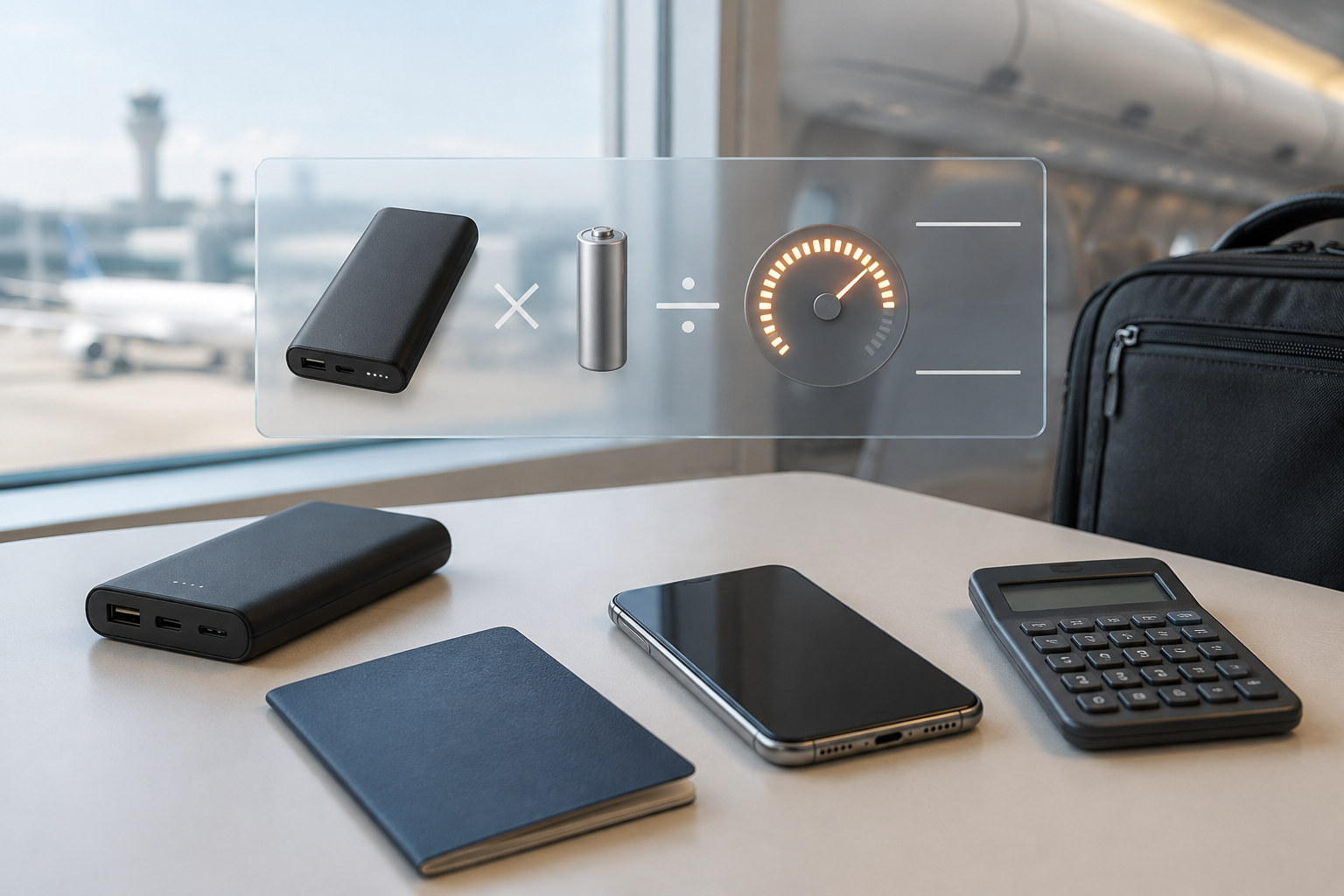
Flight limits follow the watt-hour (Wh) rating printed on the bank. If the label shows only mAh and voltage, multiply the mAh by the nominal cell voltage and divide by 1,000. A 10,000 mAh bank at 3.7V comes to 37 Wh, a 20,000 mAh bank to 74 Wh, and a 26,800 mAh bank to about 99 Wh.
The FAA allows banks up to 100 Wh in the cabin without airline approval. Banks of 101 to 160 Wh need the airline's approval, with a limit of two, and anything above 160 Wh is banned on passenger aircraft. I'd skip the middle tier: approval at a counter or gate is at the airline's discretion and hard to predict, while a bank at or under 100 Wh avoids the question.
Power banks never go in checked bags. If your carry-on gets gate-checked, take the bank out and keep it with you in the cabin, as the TSA requires.
Carriers can be stricter than the FAA, and the strictest one sets your real limit. Southwest's policy, effective April 20, 2026, allows one power bank per passenger at no more than 100 Wh. That means one bank, so buy the single bank that covers your trip rather than packing two small ones.
Southwest also bars storing the bank in an overhead bin, so it has to stay on you or in the bag under the seat in front of you. It bans recharging a power bank from the aircraft's in-seat power, and the bank has to stay visible while it charges a device. American Airlines caps carry-on spares at four under 100 Wh.
Keep the printed rating readable, too. Some travelers say Chinese airport security made them surrender banks whose printed capacity had rubbed off, even with a purchase receipt in hand. A bank that rattles around loose in a backpack for years can lose its markings.